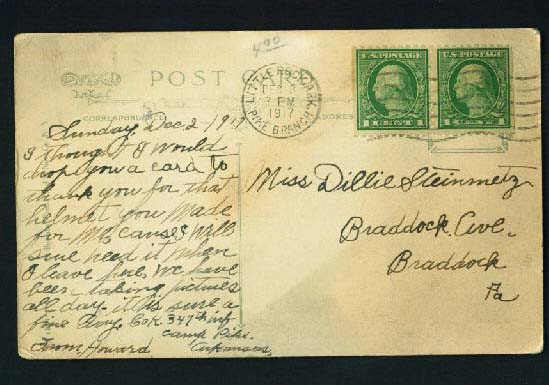
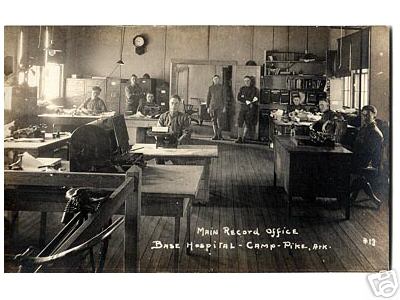
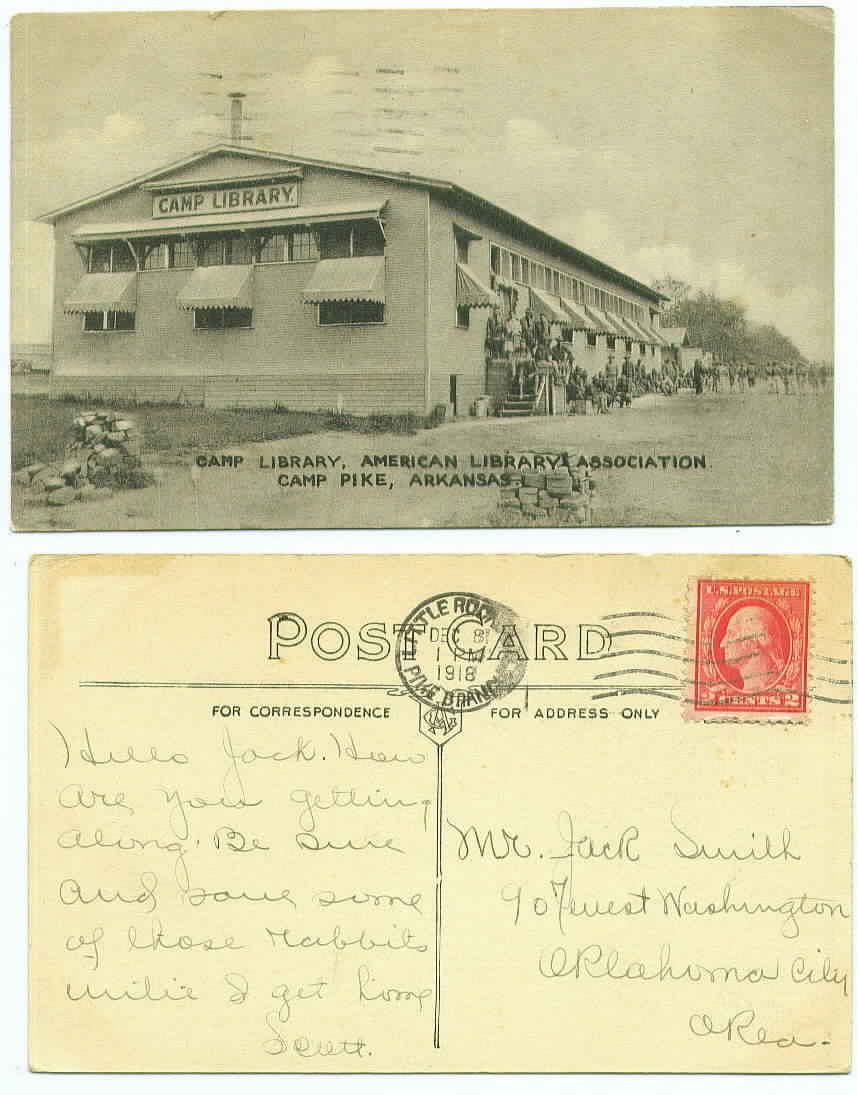
Arkansas Camp Has Major Role in the Great War
NORTH LITTLE ROCK — As Americans and the world celebrate the end of the Great War in Europe this November 11, 1918, Arkansas’s Camp Pike can look back on training more than 131,000 soldiers, many for service in France.
The war in Europe broke out in August of 1914. The Allied Powers of Great Britain, France, and Russia fought against the Central Powers of Germany and Austria. Many of smaller nations joined one side or another, creating a world war.
The United States was neutral until President Woodrow Wilson felt that German submarine attacks against unarmed ships required a declaration of war. Congress declared war against the Central Power in April of 1917, making the U.S. an associate of the Allied Powers.
When the U. S. entered the war, its standing army was about 213,000 soldiers, mostly state-based National Guardsmen on active duty on the Mexican border. The war effort would require a quick and massive enlargement of the army. In fact, by the end of the war, the U.S. would recruit, train, equip, and transport across the ocean 2.3 million men.
The War Department immediately planned for 16 new training camps, many of them in the south because the mild weather allowed year-round training. The central Arkansas area offered a supply of labor and materials, good railroad connections for moving troops and supplies, and plenty of water and good drainage.
The actual site was on the heights overlooking Little Rock, on the north side of the Arkansas River, seven miles from North Little Rock. The national government acquired 15,000 acres of land. The camp itself would occupy 3,000 acres, and the rest would be used for training exercises, or maneuvers.
The land was mostly timber, pastures and small farms. A few small communities were cleared out, leaving only scattered small cemeteries.
The new camp was named Camp Pike, in honor of General Zebulon Pike. Pike was an army officer and western explorer in the early 19th century. He named the mountain in Colorado, Pike’s Peak. A few men from his expedition were the first people of European descent to come down the Arkansas River from near its source through the future state of Arkansas.
The huge task of building Camp Pike began in July of 1917. Thousands of workers actually built a small city, with hundreds of miles of roads, barracks to house the soldiers, warehouses, and hospitals. The workers also built stables for thousands of horses and Army mules. One of the main roads to the camp would be renamed Remount Road. Two new railroad lines were also brought into the camp.
The construction of about 3,000 buildings at Camp Pike required 30 million feet of lumber, 70,000 windows, and 10,000 doors.
The first 21,773 volunteers and draftees arrived for training in September of 1917, barely two months after the start of construction. For the next year, men would come in at an average rate of 52,000 a month.
Most of the soldiers trained at Camp Pike were from Arkansas, Alabama, Mississippi, and Louisiana. They got six to eight weeks of basic training in drill, the use of rifles, and moving in small units.
In the maneuver area, trenches like those on the battlefields in France were dug, and the trainees practiced attacking and defending a trench line. They also learned to protect themselves against poison gas. Veterans of the trench lines in Europe guided the training.
The 87th Infantry Division was organized and trained at Camp Pike. It moved to Europe in June of 1918.
Now that the war has ended, Camp Pike will become a demobilization center. That is, the army will send soldiers here to be processed out of the army and back into civilian life.
Other Camp Pike information collected from the internet.
Camp Pike Armed Forces Reserve Complex
Camp Pike was established
in 1917, and was used for training the 87th Division of the National
Army. Shortly before World War II, the name was changed to Camp Joseph
T. Robinson and the camp’s boundaries were expanded to include land in
Pulaski and Faulkner counties. The camp was used for the basic training
of troops. A variety of weapons training occurred including rifles,
pistols, machine guns, live grenades, mortars and various field
artillery.
After the war, Camp Robinson was declared surplus and
broken up. Most of it was transferred to the Arkansas National Guard.
Some went to the city of North Little Rock and Central Baptist College. A
small portion was retained by the federal government for use as an Army
Reserve Center, now designated as Camp Pike. The remainder was sold to
private owners, the city of North Little Rock and Central Baptist
College. The portions that are no longer owned by the military or the
National Guard are eligible for environmental investigation and cleanup
assistance under the Formerly Used Defense Sites program. The U.S. Army
Corps of Engineers is the agency responsible for conducting
environmental restoration work under the FUDS program.
Officially
activated in April, 1996, the 90th RSC was established with
headquarters at Camp Pike Armed Forces Reserve Complex, located in North
Little Rock, Arkansas. The RSC's are each assigned a geographic region
which coincides with the Standard Federal Regions.
Camp Pike - World War I
The
United States entered World War I on April 6, 1917. To train the huge
number of soldiers that would be required, the Army announced its
intention of constructing 32 cantonments across the country. Each
cantonment would have a capacity of training between 40,000 and 50,000
soldiers at any one time.
By April 15, 1917 the Little Rock Board
of Commerce (the predecessor of today's Chamber of Commerce) was
actively involved in attempting to get a cantonment located in the
vicinity of Little Rock. They formed a Military Affairs Committee which
met daily at 10:00 a.m. This committee sent the Board of Commerce's
manager, Mr. George Firmin, to the Headquarters of the Southeastern
Department in Charleston, South Carolina and from there to Washington,
D.C. During these visits he gained valuable information on the
conditions that would have to be met for the establishment of a
cantonment.
Armed with this information, the Committee began
inspecting locations near Little Rock and soon determined that the most
suitable location was in an area north of the river. The Committee hired
engineers and had a topographical map made of the area showing contours
every 10 feet.
About this time the Committee received a lengthy
questionnaire from the Southeastern Department. The Committee
immediately called together a large number of local citizens and
established several working committees to investigate and answer,
according to their area of expertise, each of the questions submitted.
When this was completed the Committee sent a delegation to Charleston
with the completed questionnaire and other data they had prepared,
including the topographical map.
The Southeastern Department sent
an inspection team to examine and report in detail on the communities
that were applicants for cantonments. In the Twelfth divisional area, in
addition to Little Rock, these included Fort Smith in Arkansas,
Hattiesburg and Holly Springs in Mississippi and Alexandria and
Shreveport in Louisiana.
The inspection team raised some serious
concerns about the site selected by Little Rock. The primary objections
were the presence, during warm months, of the malaria carrying mosquito,
the lack of adequate rail service to the proposed site and the lack of
an adequate water supply. Not to be deterred, the Military Affairs
Committee redoubled its efforts.
The Committee engaged the
services of Dr. C.W. Garrison, the state health officer. He prepared a
demonstration that showed the mosquito could be completely eliminated
for $50,000 and the Committee immediately pledged the money to cover the
eradication.
The Committee consulted with the Missouri Pacific
Railroad On the lack of rail service. They received positive assurance
that Missouri Pacific would, upon the location of the cantonment,
immediately begin the construction of a rail line to the site with all
necessary side tracks and turnouts. The Railroad guaranteed completion
in three weeks.
The Committee then turned its attention to the
water supply problem. They engaged the services of expert well men, who
concurred with the conclusion that adequate water was not readily
available on the site. However, the well men thought adequate water
could be obtained from an underground stream in the old river bed in
Argenta (now North Little Rock). A test well was sunk and the Committee
was able to demonstrate that they could deliver the 2,500,000 gallons a
day that was required for the cantonment.
As a result of these
efforts, and in conjunction with the information already provided, the
cantonment was awarded to Little Rock on June 11, 1917. A major factor
in the decision to award the cantonment to Little Rock was the
similarity of the terrain to that of European battlefields. The Camp was
to be named for General Zebulon Montgomery Pike, the early western
explorer who discovered Pike's Peak.
The Board of Commerce called
a mass meeting of citizens and announced the award of the cantonment,
conditional on the raising of monies to meet the promises contained in
the offer. A sum of $230,000 was raised in two days, and a total of
$325,000 was raised by the time work had started on the cantonment.
Of
the monies raised $187,000 was used to purchase 3,000 acres which were
given to the United States. Another $60,000 was spent on leases for
another 10,000 acres for the duration of the war, $50,000 was set aside
for mosquito control, and $5,000 was spent on wells. The balance was set
aside for contingencies.
On June 14, 1917 Major John R. Fordyce
departed Washington, D.C. with orders to report to Little Rock for duty
as the Construction Quartermaster for Camp Pike. Major Fordyce, a Little
Rock native, had been commissioned in the Engineer Reserves in April of
1917 and had been called to active duty on May 24, 1917. Reporting to
Washington, D.C., he had spent the next several weeks studying the
proposed standard cantonment plans.
Immediately on his arrival in
Little Rock, Major Fordyce met with the president of the Missouri
Pacific Railroad, and within 3 day work had started on the spur to Camp
Pike. Realizing that the railroad would take at least three weeks to
complete, Major Fordyce constructed a road from the end of the existing
railroad to the nearest highway. This one-quarter mile road was put to
heavy use until the rail spur was completed on July 15, 1917.
While
Major Fordyce was busy getting things started, unknown to him others
were trying to get things stopped. In a newspaper article written after
the war, Fordyce wrote " I had been on the ground for 10 days, and had
sent in all these reports and had gotten up a topographical plan which
showed that a splendid camp could be laid out on the ground which the
Little Rock citizens had given up to the government. In spite of this,
no contractor had been designated to do the work and it began to look as
though the plans would fall through. While on duty in Washington, I had
seen three or four large cantonment plans for various places which had
been sent in to the construction division for consideration, rejected,
and the camp locations changed to other places. I began to be fearful
that this was going to be the fate of the camp near Little Rock. The
plans which I had sent in had been rejected and returned. I had received
rush telegrams asking more details about the health conditions and
numerous other points on which there seemed doubt. There seemed to be an
undercurrent of opposition to all our plans, and the situation appeared
so serious that the local committees were just preparing to send
another delegation on to Washington to try to find out what was holding
up the project and why no contractor had been assigned to begin building
the camp. It developed that a number of army officers stationed at Fort
Logan H. Roots had made a most adverse report about the location of the
camp near Little Rock, and this report had been sent to General Wood,
then in command of the Department of the Southeast, at Charleston. When
this report was received, General Wood, instead of concurring with the
recommendation and sending the report on to Washington, came himself to
examine conditions, and after a most thorough and exhaustive
investigation into the plan, wired the adjutant general his full
approval. After that the contractor was immediately appointed and I was
given every facility with which to rush the work. So I feel that but for
General Wood and his approval Little Rock would have lost the camp."
The
initial construction contract was given to James Stewart and Company of
St. Louis and New York and work began immediately in accordance with
plans prepared by Black and Veatch, Architects-Engineers of Kansas City,
Missouri . The contract was for the completion of 1,100 buildings
within 90 days. During the rest of the summer a work force of between
5,000 and 10,000 worked feverishly to complete the buildings and
utilities. The weekly payroll exceeded $300,000 a week. In addition to
local workers, about 1,500 workers were imported from Puerto Rico and
about 3,000 from Texas and Oklahoma to assist in the war construction
around Little Rock. The project was receiving between 80 to 100 railcars
of lumber a day; about 1,000,000 board feet of lumber received and put
up each day.
The first troops began to arrive on September 5,
1917. The first man to register was Walter Sherman Sarten, a farmer from
Bentonville, Arkansas. By September 8, 1917 there were 1,500 men in
camp; that number would grow to as many as 100,000 by the fall of 1918.
Construction on the camp was completed in December 1917.
After
arriving at the camp all new soldiers were restricted to barracks for a
ten-day quarantine to prevent the spread of contagious diseases. After
completing the quarantine the soldiers were issued uniforms and began
training. The majority of the soldiers stayed in two story wooden
structures. Sleeping quarters were on the top floor and consisted of
approximately 100 cots arranged in single rows along the two outer walls
and down the middle. Each cot had a mattress filled with straw. Located
on the first floor were a mess hall and a squad room. All cots and
mattress were moved outside each day, weather permitting, and the floors
were scrubbed.
The camp had an immediate impact on the economy
of central Arkansas. Although no records exist to determine how much of
the camp’s supplies were purchased locally, of necessity a large portion
would have been procured from sources in central Arkansas. As an
indication of the quantities of supplies needed for the camp, in the
first three months of the camp’s occupation, the quartermaster ordered:
Hay 12,000,000 pounds
Oats 9,800,000 pounds
Grain 1,000,000 pounds
Straw 2,900,000 pounds
Gasoline 60,000 gallons
Blacksmith’s coal 5,000,000 pounds
Butter/oleo 36,000 pounds each
Ice 5,000,000 pounds
Fresh beef 2,000,000 pounds
Auxiliary Remount Depot #317 was located on 160 acres on the eastern part of Camp
Pike. The Remount Depot was charged with caring for the 3,800 head of
horses and mules used by Camp Pike. The Depot consisted of five
barracks, two latrines, an officers quearters and latrine, an
administration building, a horseshoe rs' shop and a saddlers' shop. Also
on the depot were a warehouse, 25 corrals (with 9.5 miles of five-foot
high fence), 8,500 feet of double hay racks, 8,000 feet of feed troughs
and 69 water troughs. Remount Road in North Little Rock is so named
because it was the road to the Remount Depot.
Camp
Pike, Arkansas was named in honor of Brigadier General Zebulon M. Pike,
U.S. Army, discoverer of Pike's Peak; killed in action, 1818.
Established July 18, 1917 to serve as training camp for 87th Division
(National Army) , which occupied the cantonment August 1917 to June
1918. Construction started June 17, 1917 and continued through 1918.
Designated
as infantry replacement and training camp, April 1918, as infantry
training center, August 21, 1918, and as a demobilization center,
December 3, 1918. Retained as permanent reservation. Known as Camp
Joseph T. Robinson since 1937.
Camp Robinson in North
Little Rock (Pulaski County) is home to the Arkansas National Guard and
is the principal training area for the Arkansas Army National Guard. It
is also used by a number of other military and civilian agencies.
The
forerunner to Camp Robinson was known as Camp Pike, named in honor of
General Zebulon Montgomery Pike. The camp was awarded to the central
Arkansas area due to the efforts of the Little Rock Board of Commerce.
The board offered, at no cost to the U.S. government, the purchase and
lease of the lands needed to establish the post. Little Rock (Pulaski
County) was awarded the camp on June 11, 1917, and the money needed to
fulfill the promises was raised from public donations. A total of
$500,000 was raised—the equivalent of over $5 million in year 2000
dollars.
Construction began in June 1917 and was substantially
completed in November of that year. Over 10,000 workers were employed in
the construction of the camp. The construction quartermaster for the
camp was Arkansas native Major John Fordyce. Construction costs totaled
about $13,000,000.
Originally the home of the Eighty-seventh
Division, the post served as a replacement training facility after the
division deployed to France and then as a demobilization station and
home for the U.S. Third Infantry Division after the war ended. In 1922,
the 6,480 acres of land owned by the United States was deeded to
Arkansas with two provisions: that it would be used primarily for
military purposes and that the United States could reclaim the land if
needed during an emergency.
During the time between World War I
and World War II, the post served as the headquarters of the Arkansas
National Guard. Facilities to support the use of the post in this
capacity were funded by sales of unneeded materials from the original
camp. In addition, a large Civilian Conservation Corps (CCC) unit was
stationed on the post, and the post hosted Citizen's Military Training
Camps (CMTC) each summer. Future president and then-colonel Harry Truman
commanded the 1933 CMTC. In 1937, Camp Pike was renamed for the late
U.S. senator Joseph Taylor Robinson of Arkansas.
In early 1940,
the United States reclaimed the post and began construction on a
temporary cantonment for the Thirty-fifth Division, a National Guard
division being called to active duty for one year of training. Elements
of the Thirty-fifth began arriving in early January 1941. Called to
active duty for one year, the Thirty-fifth was scheduled to be released
from active duty on December 23, 1941.
With the start of World
War II, the post took on a new role as a replacement training center.
Initially, there were two centers, one for basic training and the other
for medics. In 1944, the two were combined into the Infantry Replacement
Training Center.
In addition to its role in training soldiers,
Camp Robinson also housed a large German prisoner of war facility, with a
capacity of 4,000 prisoners.
The post was Arkansas’s second
largest city, with an average daily population of about 50,000. An
estimated 750,000 soldiers had trained at Camp Robinson when training
ended in 1946 and control of the camp, which had grown to 32,000 acres,
reverted to the State of Arkansas.
Portions of Camp Robinson were
given to other organizations that demonstrated a need to the U.S.
government. The wildlife management area (WMA) north of Highway 89 and
the land where the North Little Rock airport is located were early
examples. A more recent instance was the re-designation of several
hundred acres in the southeast corner of the post as a place to
consolidate central Arkansas’s army, navy, and marine corps reserve
centers. In honor of the original name of the post, this area is now
known as Camp Pike. Most recently, land was designated for use as a
National Cemetery.
Camp Robinson continues to serve as the home
for the Arkansas National Guard’s Joint Forces Headquarters and other
Arkansas National Guard units. It is also the home of the National Guard
Bureau’s Professional Education Center and Marksmanship Training Unit.
For additional information:
Arkansas National Guard Museum. http://www.arngmuseum.com (accessed April 24, 2007).
Black
& Veach, Inc. “1941 Completion Report, Camp Robinson.” Archives.
Arkansas National Guard Museum, North Little Rock, Arkansas.
“Camp
Robinson.” GlobalSecurity.org.
http://www.globalsecurity.org/military/facility/camp-robinson.htm
(accessed April 24, 2007).
Fordyce, John. “Camp Pike Completion Report.” 1917. Archives. Arkansas National Guard Museum, North Little Rock, Arkansas.
Nieser, Tracy. “The History of Camp Pike, Arkansas.” Pulaski County Historical Review 41 (Fall 1993): 64–71.
Panamerican
Consultants, Inc. “Archaeological Investigations at the POW Camp at
Camp Joseph T. Robinson, Pulaski County, Arkansas.” March 2005.
Archives. Arkansas National Guard Museum, North Little Rock, Arkansas.
Steve Rucker
Little Rock, Arkansas
Last Updated 12/22/2008
Arkansas
Influenza
probably reached Arkansas during late September. By early October,
state officials were noting that “serious epidemics have been reported
from several points.” Most Arkansans lived in rural districts and these
were overwhelmingly hard hit by the pandemic.
Black and white panoramic image of buildings and tents at Camp Pike, Arkansas
Young
adults were especially vulnerable to the 1918 influenza virus and
military camps, such as Camp Pike, were overwhelmed with
patients.[Credit: The Library of Congress]
Fearing panic,
officials were originally reluctant to admit that the pandemic posed a
serious threat. James C. Geiger, a commissioned officer for the Public
Health Service who was stationed in the state, downplayed the threat to
Arkansans with reassuring statements even after he himself had caught
the flu and his wife died from it.
By October, the Arkansas Board
of Health was forced to put the state under quarantine. In Pulaski
County, home to Little Rock, the quarantine was not lifted until
November 4th. Across the state, public schools remained closed even
after the quarantine had been lifted. Children under eighteen were
confined to their homes until December.
The increased mobility of
people in wartime and the comparative lack of immunity among back
country dwellers meant that the epidemic swept through many communities.
The central part of the state was hit first in late September, but
Pettigrew escaped the scourge through the end of October. Charles
Crawford reported not a single case in the town on the 25th, but shortly
thereafter a public gathering at the Pettigrew school spread the virus
so thoroughly that in the space of one weekend not enough people
remained well to administer to the sick. A survivor recalled only two
deaths in the town during the epidemic, but the 1918 influenza pandemic
probably left many people in a dangerously weakened state in which they
were vulnerable to a range of diseases.
Segregation meant
African-Americans suffering from influenza were treated only by
African-American caregivers. Limited numbers of African-American
physicians meant that many people suffering from influenza were unable
to obtain the services of a physician or nurse. Additionally, as
African-Americans were also more likely to suffer from poverty, they
tended to be more vulnerable to disease and to die in larger numbers
from influenza and related diseases. While records on the deaths of
Arkansas’ African-American citizens were poorly kept, it is clear that
they died in very high numbers.
In the state’s two military
camps, Camp Eberts in Lonoke County and Camp Pike in Pulaski County, the
disease was widespread. Camp Pike was sealed and quarantined and the
camp commander insisted that the names of the dead not be released in an
attempt to still panic. Across the state, more Arkansans died from
influenza in 1918-1919 than died fighting in World War One.
The
disease slowly declined during the late fall of 1918 and it ultimately
disappeared from the state in the early spring of 1919.
Letter from William "Edd" Edward Egger, Camp Pike Arkansas 1918
I am going to France the 15th of July... William "Edd" Edward Egger, Camp Pike Arkansas 191
YMCA - WITH THE COLORS
Help Your Country by Saving, Write on BOTH Sides of This Paper.
5 Co. 1st Regiment Inf. Replacement Camp, Camp Pike, Ark
June 22, 1918
Hello Papa, How are you? By this time fine I hope. Well I am all ok and
I hope you are all well. Well I was sure glad to get that pillow. Well I
have moved today and I have not saw you a while. I hope you will come
and see me and bring me a apple that grounded at the house. I am going
to France the 15th of July.
Will I hope that George won't
haft to go to the war. Well tell Mandie and Exeum I said hello and tell
George and Rosie hello. Well tell Exeum I will write to them when I get
more time. Well I have got three stamps and have not wrote Marcy. I
haven't got a cent. I can't get you all a present till I get some money.
I wil get paid the first of this month.
Well I can't think
of much to write. Will tell all the boys to come down. We are going to
parade Little Rock the forth of July and I hope we will get to see how
you and the boys is. Well I will close for this time so answer soon and a
large letter for sure.
To one and all,
William E. Egger.
#
1917
Aug
1917 - He was sent to the training camp at Ft. Logan H. Roots near
Little Rock, Ark. In August, 1917 he was commissioned a Second
Lieutenant and ordered to Camp Pike Arkansas to take charge of the
motorcyclye dispatch service there as he had been an ardent motorcycle
...He was sent to the training camp at Ft. Logan H. Roots near Little
Rock, Ark. In August, 1917 he was commissioned a Second Lieutenant and
ordered to Camp Pike Arkansas to take charge of the motorcyclye dispatch
service there as he had been an ardent motorcycle rider for years.
After three months service at Camp Pike he was ordered to France to take
charge of the motorcycles of the advance section of the American
forces. He served in France, Germany and several other ...
Show more
Show less
From Title:<FONT SIZE=7>William Sam Rosamond </FONT> - Related web pages
freepages.genealogy.rootsweb.ancestry.com ...
#
1918
1918
- When Daddy went into the Army in 1918, he was assigned to Camp Pike,
Arkansas. Mother was carrying me and on October 30, 1918,1 was born. I
am told she had a rough time with me; was in labor for more than a day.
So the family sent a wire to my father and the ...When Daddy went into
the Army in 1918, he was assigned to Camp Pike, Arkansas. Mother was
carrying me and on October 30, 1918,1 was born. I am told she had a
rough time with me; was in labor for more than a day. So the family sent
a wire to my father and the Army gave him an emergency leave of ten
days. When he arrived home I was already born and Daddy went to see the
doctor and asks how much he owes him. The doctor says, "Well, I usually
charge ten dollars to deliver a baby ...
Show more
Show less
From The Judge - Related web pages
books.google.com/books?id=CkgBKpzKAgMC&pg=PA61 ...
#
Sep
10, 1918 - He enlisted for service in the World War September 10th,
1918, at Dickinson, North Dakota, and was at the Officer's Training
Camp, at Camp Pike, Arkansas, when the Armistice was signed. He was
honorably discharged on Decemeber 8th, 1918. Services were ...He
enlisted for service in the World War September 10th, 1918, at
Dickinson, North Dakota, and was at the Officer's Training Camp, at Camp
Pike, Arkansas, when the Armistice was signed. He was honorably
discharged on Decemeber 8th, 1918. Services were held at Edgerton on
Friday afternoon, and the body was brought to Colby Saturday for burial.
Christian Science services were conducted at the cemetery. A military
salute was given and taps sounded by the American Legion.
Show more
Show less
From Obit: Blanchard, Horace J. (1882 – 1935) - Related web pages
www.usgennet.org/usa/wi/county/clark/webbbs ...
#
1919
Nov
12, 1919 - He returned to the United States on the USS “Bogahontis” and
was discharged at Camp Pike, Arkansas on November 12, 1919. The
National World War I Museum, officially designated by the US Congress,
is the only American museum solely dedicated to preserving ...As a
doughboy, Buckles drove motorcycle sidecars and ambulances in England
and France. After the Armistice, he was with a POW Escort Company
returning prisoners to Germany. He returned to the United States on the
USS “Bogahontis” and was discharged at Camp Pike, Arkansas on November
12, 1919. The National World War I Museum, officially designated by the
US Congress, is the only American museum solely dedicated to preserving
the objects, history and personal ...
Show more
Show less
From Last Known American WWI Vet to Visit National World War I Museum In … - Related web pages
freshare.net/article ...
#
1937
1937
- In 1937, Camp Pike was renamed Camp Joseph T. Robinson. After World
War II, along with distribution of surplus land, many of the wooden
buildings at Camp Robinson were given away also. Some were moved or
dismantled and rebuilt on the campus of Arkansas State ...In 1937, Camp
Pike was renamed Camp Joseph T. Robinson. After World War II, along with
distribution of surplus land, many of the wooden buildings at Camp
Robinson were given away also. Some were moved or dismantled and rebuilt
on the campus of Arkansas State Teachers College, today's University of
Central Arkansas. Others went to public schools, churches and private
ownership for businesses and housing. (Information sources include
Arkansas Game and Fish Commission, US ...
Show more
Show less
From World War II brought major changes to the Conway area - Related web pages
www.thecabin.net/stories/090708/loc_0907080018 ...
The
construction of Camp Pike began in July of 1917. It was named in honor
of General Zebulon Pike, an army officer and western explorer in the
early 19th century, and was situated on the heights overlooking Little
Rock.
The camp was completed in December of 1917 and was like a
small city with hundreds of miles of roads, barracks to house the
soldiers, warehouses, and hospitals. Stables were also built for
thousands of horses and Army mules. On September 5, 1917, the first
troops arrived and by the fall of 1918 the camp had grown to as many as
100,000.